
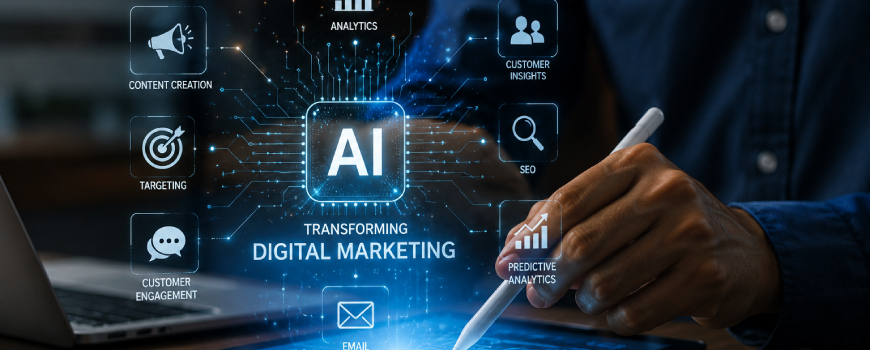
The digital landscape hasn’t just evolved; it has completely transformed. If you are still relying on the static marketing playbooks of a couple of years ago, your brand is likely fading into digital background noise. Today, AI in digital marketing 2026 is no longer an experimental luxury or a simple tool for drafting quick social media captions. It is the core operating system driving the most successful brands online.
For forward-thinking agencies and business owners, such as the team at The Markup Group, navigating this shift requires a deep understanding of how artificial intelligence in marketing reshapes consumer behavior, search algorithms, and data processing. From automated media buying to hyper-personalized marketing campaigns, let’s explore exactly how deep this integration runs and how you can leverage these digital marketing trends 2026 to grow your business.
1. The Death of Generic Content: Enter Hyper-Personalized Marketing
Audiences in 2026 have zero tolerance for generic, blast-to-all marketing messages. Consumers expect brands to understand their exact pain points, preferences, and real-time intent. This expectation has turned hyper-personalized marketing into the standard protocol for customer retention and acquisition.
Instead of segmenting audiences into broad demographics (e.g., ‘millennials interested in tech’), modern AI engines process real-time contextual data to build unique consumer profiles on the fly. This allows systems to change website structures, email sequences, and ad creatives dynamically for every single user.
2. Beyond Keywords: AI SEO Strategies & Conversational Search
The traditional SEO model of stuffing high-volume terms into blog posts is officially dead. With advanced conversational search engines, AI overviews, and LLM-driven query bots handling the majority of daily searches, search engine optimization requires next-generation AI SEO strategies.
People no longer type broken phrases like ‘best digital marketing agency New York.’ Instead, they speak naturally to their devices: ‘Find a digital marketing agency near me that specializes in mid-market SaaS scaling and has verified reviews.’ To capture this traffic, your content must focus heavily on deep semantic relevance, user intent fulfillment, and direct answering frameworks.
• Optimizing for LLM Citations: Focus on becoming the primary source of original research, proprietary data, and authoritative insights that AI models crawl and cite.
• Contextual Search Mapping: Structure your content layout with clear answer tables, robust FAQ blocks, and technical schema that allows AI engines to parse your value proposition instantly.
Is Your Website Ready for the Conversational Search Era?
Don’t let your business get left behind by next-generation AI filters and conversational engines. Let our team analyze your current setup and build a future-proof roadmap.
3. Predictive Analytics Marketing: Anticipating the Customer Journey
Reactive marketing—where you look at last month’s Google Analytics report to decide next month’s budget—is a fast track to falling behind. Leading brands now use predictive analytics marketing to identify market shifts and consumer needs before they manifest explicitly.
By analyzing historical touchpoints, social listening data, and macroeconomic trends, AI engines accurately predict which customer segments are likely to churn, which products will spike in demand next quarter, and exactly when a prospect is moving from the ‘awareness’ phase to the ‘decision’ phase. This allows marketing teams to deploy targeted retention offers and ad spends exactly when they will yield the highest return on investment (ROI).
4. Autonomous Ad Optimization and Multi-Channel Orchestration
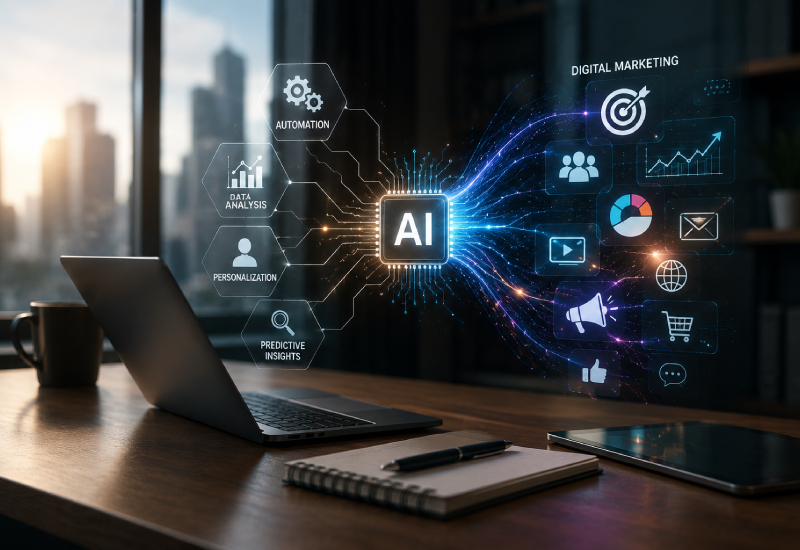
The days of manual A/B testing, where marketers painstakingly swap out headlines or tweak background colors over weeks, are gone. Autonomous ad management platforms now execute tens of thousands of micro-variations simultaneously across multiple networks.
AI agents continuously analyze performance metrics across Google, Meta, TikTok, and emerging spatial computing networks. The system automatically shifts budgets from underperforming creatives to high-yielding assets in milliseconds, ensuring that paid media spend is constantly optimized without human delay.
5. Balancing Automated Scale with Human Credibility
With the explosion of synthetic media, consumers are craving genuine human connection more than ever. The absolute winners in the era of artificial intelligence in marketing are not those who automate everything blindly, but those who combine AI’s unmatched analytical efficiency with genuine human storytelling.
At The Markup Group, the sweet spot lies in using AI to handle deep data mining, administrative structuralization, and initial content frameworks, while relying on skilled human strategists to inject empathy, cultural nuance, verified case studies, and brand voice. This hybrid model ensures your brand scales its output without sacrificing the trust that converts casual readers into lifelong clients.
Conclusion: The Action Plan for The Markup Group
Embracing AI in digital marketing 2026 isn’t about replacing your marketing team; it’s about upgrading them with supercomputers. To remain competitive, brands must actively transition away from static strategies and adopt continuous, data-driven, and hyper-personalized frameworks.
Start by auditing your current tech stack. Ensure your SEO incorporates robust AI SEO strategies, upgrade your CRM data pipelines to leverage predictive analytics marketing, and always keep human authenticity at the core of your creative output. The future belongs to those who blend intelligence with intuition.
Ready to Transform Your Marketing from Reactive to Predictive?
At The Markup Group, we combine cutting-edge artificial intelligence infrastructure with the indispensable human touch to scale your traffic, optimize your ad spend, and drive real ROI.
Frequently Asked Questions (FAQs)
In previous years, AI was primarily used as a reactive tool—such as basic copy generation or rudimentary chatbots. In 2026, AI operates proactively through advanced predictive analytics marketing, autonomous omni-channel ad management, and highly conversational AI SEO strategies that optimize content for voice and LLM engines seamlessly.
Traditional SEO heavily emphasized exact keyword matches and link volume. Modern AI SEO strategies focus on semantic matching, deep user intent fulfillment, and formatting content so that large language models (LLMs) can easily crawl, synthesize, and cite your brand directly within conversational search answers.
Not if executed correctly. Current hyper-personalized marketing frameworks rely on zero-party and first-party data provided voluntarily by users, combined with localized edge computing and privacy-compliant predictive modeling, allowing personalized experiences to occur without breaching modern data regulations.
Absolutely. In fact, AI levels the playing field. Many advanced AI marketing tools operate on scalable, SaaS-based models, giving boutique agencies and small businesses access to elite-level data processing, automation, and predictive analytics that used to require seven-figure custom enterprise infrastructure.
No. Total automation often leads to generic content that lacks real authority, which can cause drops in user trust and search engine rankings. The ideal strategy is a collaborative approach: use AI to gather data insights, create outlines, and brainstorm angles, but keep human editors to ensure brand alignment, emotional depth, and practical credibility.
- 📧 Email: themarkupgroup@gmail.com
- 📞 Phone: +91 99090 39977
- 🌐 Visit: www.markupproperty.com

About Author
Sweta Pandya
Ms. Sweta Pandya, CEO of Markup Marketing, is a performance marketing expert with an MBA and a passion for driving brand success. With a strong track record across industries like real estate, healthcare, e-commerce, and finance, she specializes in Social Media Marketing, SEO, Paid Advertising, Branding, and UI/UX Design.
Under her leadership, Markup Marketing delivers high-impact, data-driven strategies with an impressive success rate. Through this blog, Sweta shares insights and trends to help businesses thrive in the digital space. Connect with her to elevate your brand’s online presence!